





Health & Education
We all want the best care possible for our horses. The Heath & Education section covers both Learning Institutions, Organizations as well as many sources for equine assistance including Veterinarians and Farriers.
For those who want a to formally study horses, the Education section includes College Riding, Equine Studies, and Veterinary Schools. Learn about the wide variety of horses in the Horse Breeds section. Supplements and Treatments Therapy are also included in the section.
Everyone can learn from Fine Art and there are some specialty Museums that might surprise you.
Horses as a therapy partner enrich the lives of the disabled. These facilities are listed in our Therapeutic Riding section. To help children and young adults build confidence and grow emotionally, please see the resources available on the Youth Outreach page.
Looking for a place to keep your horse? You can find it in the Horse Boarding section. Traveling? Find a Shipping company or Horse Sitting service if your horse is staying home!
Want to stay up to date with the latest training clinics or professional conferences? Take a look at our Calendar of Events for Health & Education for the dates and locations of upcoming events.
Do we need to add more? Please use the useful feedback link and let us know!
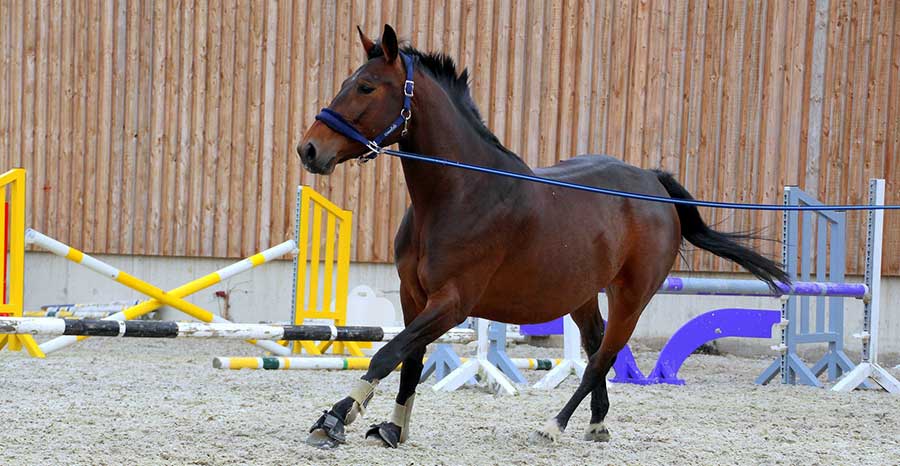
Training a horse is a challenging but necessary part of equine ownership. If you don’t train your horse, it will become unruly and hard to manage as it reaches adulthood. Independently of which horse breed you own, maybe it’s a Shetland pony or maybe an Arabian horse, training it will take time, but the rewards are there if you can pull it off.
Set Goals
Before you start training your horse, it’s important to know your main objective. Some people just want to ride their horses around a field; some want to take their horses onto the road, and some want to take their horses around the country in trailers. Whatever goal you have, make sure you take it step-by-step and don’t rush things. If you want to teach your horse to get into the trailer, you have to get it used to the trailer first but if what you want is to ride your horse, it would be best to get it used to having a saddle on first.
Trust
Having your horse’s trust is one of the most important aspects of training. If your horse doesn’t trust you, it won’t listen to you, and you’ll waste hours training it when it’s in a state that won’t accept any training. You need to build that trust over time by doing simple things like grooming it, spending time with it, walking it, etc. Once you’ve built up that trust, only then can you begin training it.
by Jackie Bellamy-Zions
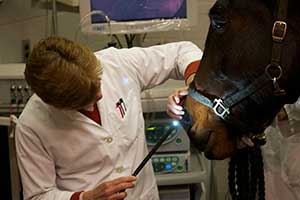
Heaves is known as a disease that can leave a horse struggling to breathe, ending athletic careers and even rendering a pleasure horse unsuitable for riding. Commonly known today as equine asthma, it’s an irreversible disease brought on by repeated exposure to dust and moulds. Ontario Veterinary College researcher, Doctor Bienzle has a long history of primary and collaborative work studying asthma in horses. Her most recent contributions include working with a group of researchers in Slovenia, investigating stem cells as a potential treatment option.
Bienzle explains the usual causes of heaves are long term exposure to dusty or mouldy hay, bedding, dusty environments and sometimes even grass in hot humid climates that provide the right conditions for mould to thrive. “Horses get sensitized to these components in the inhaled air and with time, they develop airway inflammation and that begins to manifest with occasional coughing or runny nose.”
With continued exposure to the same particulates, the condition worsens, and the coughing becomes more continuous. The nose may be running and then there is thickening of the bronchial wall in the lung. There is extra smooth muscle being laid down and it becomes hard for the horse to exhale against mucus and inflammatory cells in the lumen of the airway.
In the later stages of disease, horses can develop a ‘heaves line’ (hypertrophic abdominal muscles are recruited to assist with exhaling air). By the time equine asthma is diagnosed, it has usually been present for a few years, if not several. Treatment of the symptoms includes immunosuppression, but the disease cannot be reversed.
Read more: Stem Cells Under Investigation as a Possible Future Treatment for Equine Asthma
- Fitness for the Pregnant Rider - an excerpt from "Ultimate Exercise Routines for Riders"
- Published: Canagliflozin for Control of Refractory Equine Hyperinsulinemia and Laminitis
- Building Your Horse’s Confidence
- Help Nix the Culex Mosquito that Transmits 3 of 5 Core Equine Diseases
- Communication Between Human and Horse
- Research into Development of the Foal’s Gut Could Advance Treatment of Critical Cases of Diarrhea
- Mosquitoes Undeterred by Drought – 4 Tips to Protect Your Horse
- An Equine Methionine Crisis is Brewing
- Beware Supplemental Iron
- Sugar Does Not Cause Equine Metabolic Syndrome
- Welcome to London College of Animal Osteopathy (LCAO) (2:17)
- Katie Navarra Coaching - Reset: Reconnect: Reframe
- The New Foal Exam with Dr Laurie Metcalfe - Rood & Riddle Stallside Podcast
- Solving a Mare’s ‘Behavioral’ Problems
- Wintertime Equine Nutrition: 3 Facts
- The Heart of Laminitis Care
- Our First Year with Dr Peter Morresey and Dr Bart Barber
- What’s New in Equine Healthcare with Dr Peter Morresey and Dr Bart Barber
- EHV-1 Research Study and Infection Control Tips
- Hoof Care in Winter