




Revolutionary, That Is...
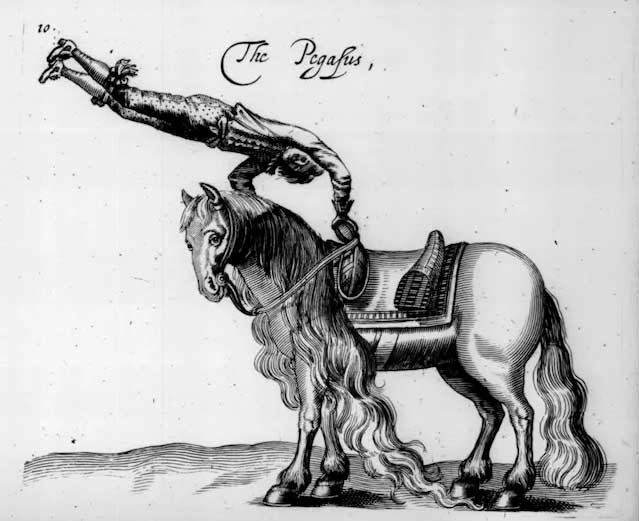
The Vaulting Master, or The Art of Vaulting reduced to a Method comprized under certaine Rules
Illustrated by Examples, and Now primarily set forth by Will: Stokes. 1652.
by Judith Martin Woodall
Part One
In the old part of the city, in the shadow of the Manhattan Bridge, there is a block on Elizabeth Street between Hester and Canal, lined with tenements, Chinese restaurants, and a parking garage whose 18th century past is evident only in the block’s boundaries. There was no Canal Street then; it was St. Nicholas or Pump Street. Hester was Eagle Street on some maps, and Bowery Lane, the block’s easterly boundary, cut through open land, farms, orchards, and estates, as it proceeded up the island. The nearby Bull’s Head Tavern,[i] gave its name to the cattle markets, slaughterhouses and tanneries situated to the south of the block. The tavern, a stop for stage coaches traveling the Post Road from New York to Boston, was a popular gathering place providing important word-of-mouth advertising for the trick riders who found space nearby to set up their manèges.
Joseph Faulks
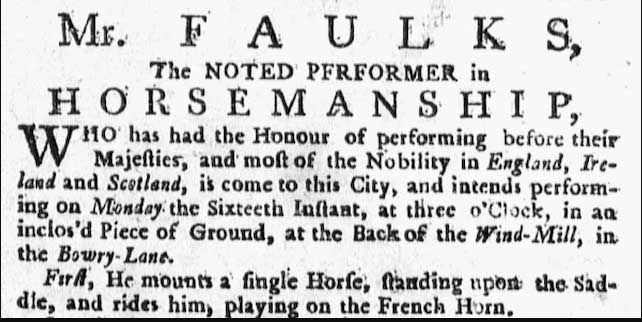
On December 16, 1771, New-Yorkers paid four shillings to head uptown to an “inclos’d Piece of Ground, at the Back [Elizabeth Street] of the Wind-Mill in Bowery lane,” above the slaughter-house to watch “Mr. Faulks, the noted Performer in Horsemanship,” [ii] canter into the ring, standing upright on the back of his horse while playing a French horn. The tune was not mentioned, but Faulks claimed “the Honour of performing before their Majesties, and most of the Nobility in England, Ireland and Scotland.” Never mind, that of late, their Majesties and most of the nobility had been losing their luster in the Thirteen Colonies.
Feats of daring on horseback are very nearly irresistible at one time in a rider’s life and have been a source of fun likely from the moment when Central Asians decided that horses could transport people as well as goods. Vaulting on and off horses was the first method of mounting and dismounting before stirrups became an essential piece of tack. More than two millenniums ago, Xenophon––Greek historian, general, philosopher, and author of On Horsemanship––described the correct method for a rider to spring onto a horse’s back. He recommended that all riders practice springing up from the near (left) and off (right) sides of the horse, a skill necessary for rapid mounting in the face of an approaching enemy and a horse cavalry requirement ever since.
From these early practices, vaulting at speed with more complicated movements became a component of cavalry exercises and existed alongside the elaborate and formal horsemanship displays in the courts of Europe in the 17th century. These two faces of horsemanship came to represent the training integral to the aristocracy and the forces they led––a marriage whose descendants are the equestrian sports of today.
[i] The name lived on as the markets migrated uptown to the East Twenties, the area where major horse dealers maintained large stables. The original tavern was located at what is now approximately 50-52 Bowery in 2013.
[ii] New York Journal, or, the General Advertiser. December 12, 1771.
Read the Entire Article - Click Here
All photos courtesy of Judith Martin Woodall.
There are more fascinating stories in our section on Recreation & Lifestyle.