




Health & Education
We all want the best care possible for our horses. The Heath & Education section covers both Learning Institutions, Organizations as well as many sources for equine assistance including Veterinarians and Farriers.
For those who want a to formally study horses, the Education section includes College Riding, Equine Studies, and Veterinary Schools. Learn about the wide variety of horses in the Horse Breeds section. Supplements and Treatments Therapy are also included in the section.
Everyone can learn from Fine Art and there are some specialty Museums that might surprise you.
Horses as a therapy partner enrich the lives of the disabled. These facilities are listed in our Therapeutic Riding section. To help children and young adults build confidence and grow emotionally, please see the resources available on the Youth Outreach page.
Looking for a place to keep your horse? You can find it in the Horse Boarding section. Traveling? Find a Shipping company or Horse Sitting service if your horse is staying home!
Want to stay up to date with the latest training clinics or professional conferences? Take a look at our Calendar of Events for Health & Education for the dates and locations of upcoming events.
Do we need to add more? Please use the useful feedback link and let us know!
Andrea Boone and Larissa Strappello demonstrate a sample 15 minute first trot lesson format in a Certified Horsemanship Association (CHA) riding instructor English/ Western Certification. Visit CHA.horse to find a Certified Horsemanship Association near you.
Read more: Sample Lesson on First Trot with Andrea Boone (16:49)
by Preston Hickman, DVM, Wichita Equine and Sports Medicine
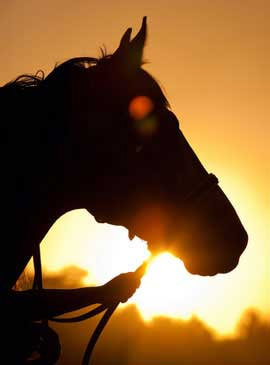
A horse asked to perform strenuous exercise often is pushed to the limits of his body's mechanisms to recover. In most cases, these mechanisms allow the horse to finish the exercise with no problem. Sometimes, however, the horse's ability to recover may be inadequate and will result in possible heatstroke or exhaustion.
This means that more than one organ system might stop functioning properly, such as the muscles, kidneys, central nervous system, or clotting system. Without prompt intervention the horse might suffer irreversible damage.
When the sum of outside temperature plus the relative humidity is below 130 (e.g., 70 F with 50% humidity), most horses can keep their body cool. The exception will be very muscular or fat horses. When the sum temperature and humidity exceeds 150 (e.g., 85 F and 90% humidity), it is hard for any horse to keep cool.
If the humidity contributes over half of the 150, it compromises the horse’s ability to sweat. When the combination of temperature and humidity exceeds 180 (e.g., 95 F and 90% humidity), the horse’s cooling system is ineffectual and very little cooling takes place even if the horse is sweating profusely.
At this stage, exercise can only be maintained for a short time without the animal’s body temperature— especially in the muscles— rising to dangerous levels. When the horse’s body temperature has reached 105 F, the blood supply to the muscles will begin to shut down.
After this occurs, the blood supply to the intestines and kidneys will also shut down. The blood supply to the brain and heart are spared until last, but severe and permanent damage may have already taken place.
The body maintains its normal temperature in hot weather by moving heat through the muscles and out through the skin. Blood also removes heat as it circulates through the body and releases it through lung tissue, skin and expanding blood vessels.
This is why blood vessels may appear larger and more distended during hot weather. This dilatation and resulting perspiration serves to cool the skin and body as the sweat evaporates. Horses that cannot sweat will usually overheat and heatstroke very rapidly, even in cooler weather with a small amount of exercise.
The chance of overworking a horse (exhaustion) rapidly increases when any of the following conditions exist: heat and humidity, poor fitness, obesity, the presence of another disease or lameness, high altitude, rough or steep terrain, rider inexperience, or if the horse has the inability to sweat. Exhaustion is noted by fatigue and inability to cool himself alone.
In contrast, heatstroke resembles a horse tying up and or in shock, but can resemble a horse with exhaustion when they collapse. An exhausted horse might be distressed and anxious. He might have a high heart and respiratory rate that does not decrease with rest and his skin might feel hot and dry.
Signs of shock with heatstroke, however, include pale, dry mucous membranes, increased capillary refill time, increased jugular vein fill time, a weak, irregular pulse, and no gut sounds. Some horses become stiff and experience pain due to muscle cell damage, which can be detected by observing red or brown urine (hemoglobin and/or myoglobin uria).
Horses affected this badly might go down or develop other, often life-threatening conditions such as laminitis, kidney failure, or diarrhea. A badly effected horse also might appear wobbly or demented.
- Putting Weight on a Skinny Horse
- The Export Journey of the Icelandic Horse (22:17)
- Why Wear a Helmet? Riders Share Harrowing Close Calls
- Equine Affaire Educational Program - Monty Roberts performs Join-Up with a Wild Horse (22:37)
- Veterinarian, Equestrian Advises on Caring for the Senior Show Horse
- Rood & Riddle "Stallside" Podcast - Scratches and Hives Oh My! with Dr Julia Miller
- Your Child Wants to Ride a Horse! What Should You Do?
- Biosecurity Education & Training
- Sample Lesson: First Lope with Tara Reimer (17:12)
- Obese Equine Athletes: Are These “Unhealthy” Healthy Horses?
- Facility Design with Biosecurity in Mind
- What's In Your Hay?
- Reading Horse Behavior with Dale Rudin (7:55)
- Why Do Horse Breeders Terminate a Twin?
- Rood & Riddle Stallside Podcast: The Importance of Ultrasound with Dr Colton Thacker (26:33)
- Infection Disease Control tips for Horse Farms - Dr. Scott Weese (15:62)
- Why the Sudden Behavior Change in My Horse?
- Hydrolyzable Carbohydrates and the Metabolic Horse
- Rood & Riddle Stallside Podcast - 0:03 / 27:14 • Intro The Most Interesting Guest so Far with Dr Bart Barber - Episode 50!
- Catching the Horse in a Paddock with Teresa Kackert (5:29)