




Health & Education
We all want the best care possible for our horses. The Heath & Education section covers both Learning Institutions, Organizations as well as many sources for equine assistance including Veterinarians and Farriers.
For those who want a to formally study horses, the Education section includes College Riding, Equine Studies, and Veterinary Schools. Learn about the wide variety of horses in the Horse Breeds section. Supplements and Treatments Therapy are also included in the section.
Everyone can learn from Fine Art and there are some specialty Museums that might surprise you.
Horses as a therapy partner enrich the lives of the disabled. These facilities are listed in our Therapeutic Riding section. To help children and young adults build confidence and grow emotionally, please see the resources available on the Youth Outreach page.
Looking for a place to keep your horse? You can find it in the Horse Boarding section. Traveling? Find a Shipping company or Horse Sitting service if your horse is staying home!
Want to stay up to date with the latest training clinics or professional conferences? Take a look at our Calendar of Events for Health & Education for the dates and locations of upcoming events.
Do we need to add more? Please use the useful feedback link and let us know!
Equestrian World travelled to a remote part of the island more than 100 km from Reykjavik to meet Gunnar Sturluson, an Icelandic Horse breeder and President of FEIF, the International Federation of Icelandic Horse Associations, at his 'Hrísdalur' farm. We also visit Guðmar Þór Pétursson at his farm Hestaland, offering riding tours and instruction all year round.
Read more: The Uniqueness of Icelandic horses, Part 2 (7:15)
By Kentucky Equine Research Staff
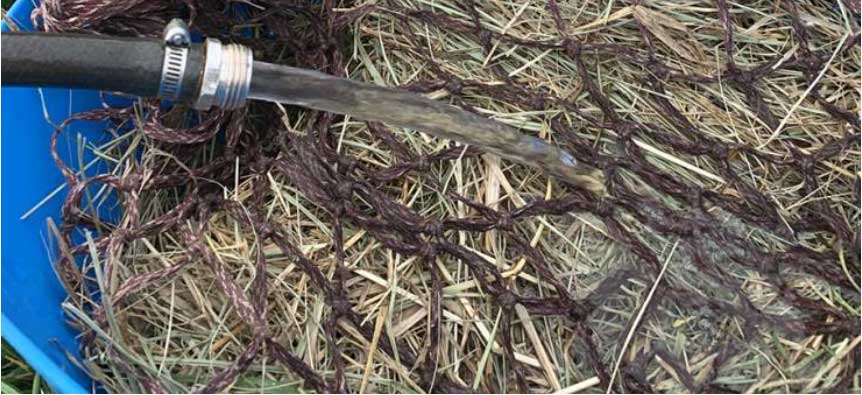
Hay produces dust particles that contain mold, endotoxins, mites, and other microscopic antigens. Inhaling those respirable dust particles is the most significant exacerbator of severe equine asthma (SEA). While studies show that hay soaking decreases the production of dust particles, only one study performed to date demonstrates that hay soaking improves lung function.*
In that study, 10 horses with SEA belonging to the Equine Asthma Research Laboratory at the University of Montreal, Canada, were recruited. All horses were in exacerbation at the start of the six-week study. Horses were split into two groups and fed either soaked alfalfa pellets in a feeder or hay that had been soaked in cold water for 45 minutes before feeding at ground level. At baseline and again at the end of the study, airway inflammation was measured via bronchoalveolar lavage (BAL, a “lung wash”), and tracheal mucous scoring was performed. On weeks 0, 2, 4, and 6, researchers assigned respiratory clinical scores based on nasal flare and abdominal effort while breathing. They also measured lung function, as determined by lung resistance/obstruction, during those weeks.
“Clinical respiratory scores and pulmonary function improved significantly during the study in both groups of horses,” explained Ashley Fowler, Ph.D., a Kentucky Equine Research nutritionist.
No significant improvement, however, was noted in airway inflammation in the soaked hay group based on BAL findings of “pulmonary neutrophilia.” This means that a specific type of white blood cell, called neutrophils, persisted in the BAL fluid throughout the treatment period.
“Pulmonary neutrophilia is known to occur when respirable dust exists in the horse’s breathing zone—the two-foot sphere around the nose,” Fowler said.
Despite effectively reducing respirable particles, hay soaking is perceived as cumbersome by many owners, resulting in poor compliance. Further, alternatives to hay soaking such as expensive pellets, oil-mixed hay, and haylage/silage also have limitations. Nonetheless, methods that decrease respirable particles are essential for decreasing the clinical signs of SEA, including labored breathing, coughing, and increased mucus production.
“Because SEA is characterized by inflammation, current recommendations include adding marine-derived anti-inflammatory omega-3 fatty acids to the diet.** Kentucky Equine Research offers EO-3 and ReSolvin EQ, both of which contain EPA and DHA in a palatable formula,” Fowler said.
Owners are also encouraged to decrease dust in the horse’s environment through ventilation and other management practices like turnout and low-dust bedding.
Read more: Beyond Dust Reduction: Soaking Hay Improves Lung Function
- Air Quality and Air Pollution’s Impact on Your Horse’s Lungs
- Restricting Forage is Incredibly Stressful
- Reading the Horse's Vital Signs with Teddy Franke (1:43)
- The Uniqueness of Icelandic horses - Part 1 (8:02)
- Blanketing the Horse Safely with Tammi Gainer (8:35)
- Riding Exercises to Improve Rider Position with Christy Landwehr
- Why Wear a Helmet? Riders Share Harrowing Close Calls
- Monty Robert's 88th Birthday - Cutting (43:03)
- Good Riding Position with Ken Najorka (8:06)
- Four Signs of a Happy Horse
- Seedy Toe White Line Disease
- Core Conditioning for Horses - Book Trailer
- Respiratory Challenges in Horses, Part 1: Equine Influenza
- Horse Blanketing Guide
- FAQ: Is Your Horse Choking?
- Every Horse Needs These Five Things (2)
- Every Horse Needs These Five Things
- Horse Gentler Monty Roberts Tames a Wild Horse In Front of 30,000 Brazilians
- Body Condition Index: New Tool for Objectively Assessing Body Fat in Horses
- 5 Gaits of the Icelandic Horse (2:24)