



Health & Education
We all want the best care possible for our horses. The Heath & Education section covers both Learning Institutions, Organizations as well as many sources for equine assistance including Veterinarians and Farriers.
For those who want a to formally study horses, the Education section includes College Riding, Equine Studies, and Veterinary Schools. Learn about the wide variety of horses in the Horse Breeds section. Supplements and Treatments Therapy are also included in the section.
Everyone can learn from Fine Art and there are some specialty Museums that might surprise you.
Horses as a therapy partner enrich the lives of the disabled. These facilities are listed in our Therapeutic Riding section. To help children and young adults build confidence and grow emotionally, please see the resources available on the Youth Outreach page.
Looking for a place to keep your horse? You can find it in the Horse Boarding section. Traveling? Find a Shipping company or Horse Sitting service if your horse is staying home!
Want to stay up to date with the latest training clinics or professional conferences? Take a look at our Calendar of Events for Health & Education for the dates and locations of upcoming events.
Do we need to add more? Please use the useful feedback link and let us know!
By Juliet M. Getty, Ph.D.
Guidelines from Dr. Getty on feeding the horse in transition to domesticated
If there’s one thing we can say about the benefit of being wild (or feral, in healthful surroundings) is that in most circumstances horses which have been free to roam open lands are often healthier than domesticated horses. Think about their diet for starters—they have so much variety—grasses, flowers, berries, leaves, seeds, fruits—providing all the nutrients their bodies need. Once they leave this natural setting, however, they typically eat only hay and it’s the same hay every day. Hay is dead grass and no longer contains the vitamins found in their previous, varied diet. The horse’s nutrition gaps will need to be filled in order to match the rich nutrition of the wildenvironment. Therefore, to fill in the nutritional gaps:
Provide a comprehensive vitamin/mineral supplement along with chia seeds and ground flaxseeds for omega 3s
Horses in the wild rarely experience colic. One of the main reasons for colic in the domesticated situation is the rapid change from one feed to another, leaving the bacterial hindgut population little time to adjust. These microbes are responsible for digesting the fiber found in forage (hay and/or pasture) and need to be protected. To help your new horse’s digestive system adjust:
Feed a potent probiotic that contains billions of colony forming units (CFUs)
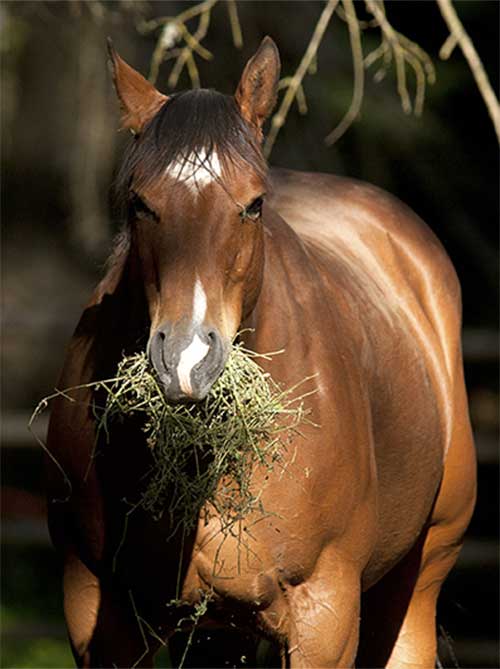
Ulcers are common in domesticated horses, especially when transitioning to a new environment. Horses are trickle feeders – they need to graze continuously to keep the digestive system functioning normally. That means they should have quality hay 24/7. Horses are awake and moving most of the time and will take 15 to 20 minute naps intermittently throughout the day and night. The best way to protect your new horse against an ulcer is to:
Feed him in sync with his natural instinct to continuously graze by giving him hay, free-choice
Many wild horses get adopted when they are young. They require the variety of feed sources that they had in the wild that offered quality protein, fat, vitamins, and minerals to support new growth. To accomplish this, add some alfalfa to your horse’s diet (about 30% of the total hay ration), along with either a supplement or a commercially fortified feed. Avoid cereal grains (oats, corn, etc.) and molasses – they can interfere with normal bone and joint development. In general:
Feed growing horses extra protein, vitamins and minerals, chia seeds and ground flaxseeds to provide omega 3s, while avoiding high amounts of starch
Respect your horse’s need to roam, along with other horses. Naturally curious, they enjoy seeking out feed in various locations, feeding their bodies, but also providing movement to keep the digestive tract muscles in good tone. And being prey animals, they depend on the companionship of other horses to protect them against threats, real and imagined. This transition phase can be stressful – new sights, smells, people, and other animals can create a hormonal response that can lead to a variety of health problems, including ulcers, colic, and laminitis. All of these can be avoided by making slow adjustments, filling in nutritional gaps, and doing as much as possible to simulate a natural setting. In other words…
- Feed him like he was meant to be fed – like a horse.
This article originally appeared on Getty Equine Nutrition and is published here with permission.
Find more informative articles in our section on Health & Education.
In episode #64 of StallSide, we dive into thoroughbred stallion management with Sandy Hatfield; hosted by doctors Bart Barber and Peter Morresey, this episode offers a glimpse into the life of the esteemed Stallion Manager at Three Chimneys Farm. Listeners can learn about the unique challenges and joys that come with the job of a Stallion Manager.
Sandy Hatfield discusses the importance of patience, socialization, exercise, personalities, teaser stallions, and training of breeding stallions. Her insights provide a valuable perspective for both seasoned breeders and those new to the world of thoroughbred breeding.
- The Horses of Iceland - Many Different Colors
- Minis – A Big Horse in a Little Package
- Holding the Horse for the Vet or Farrier with Julie Goodnight (7:03)
- Fitting the Martigale with Julie Goodnight (12:33)
- Colic in Horses, Explained
- Lengthening and Shortening the Horse's Strides with Ann Brzezicki (20:31)
- Equine Asthma: Current Understanding and Future Directions Research - Dr Dorothee Bienzle (14:25)
- The Real Cost of Horse Ownership - Jackie Bellamy-Zions (5:51)
- Keeping Dogs Safe around Horses and Livestock
- 5 Winter Plus Senior Horse Care Tips
- How to Measure for Hoof Boots
- The Benefit of Barn Cats!
- Treating a foal's Overbite with Dr Brad Tanner from Rood & Riddle Equine Hospital
- Biosecurity for Horse Owners
- Biosecurity: When and How to Isolate
- Do You Ride Big or Small? and excerpt from "Ride Big" by John Haime
- Rood & Riddle "Stallside" Podcast - The Science and Benefits of Equine Plasma with Sarah Myer Thompson (38:11)
- Olfactory Stimulation Enriches Horses’ Environments
- Whole Food Options to Boost Protein Quality
- Monty Roberts Gentling Your Spooky Horse (4:17)