




Recreation & Lifestyle
Welcome to Recreation & Lifestyle, which includes leisure riding and other aspects of the equestrian lifestyle for you and your horse loving friends and family.
Looking for the perfect present? See the Gifts & Jewelry section. Redecorating? Find a Painting, Photograph or Sculpture in the Artwork section. Need to check out a movie or crawl up with a good book or magazine? See our Entertainment section where you will find and Books, Movies, Games, and Magazines. And don't forget about Fine Art in some specialty Museums that might surprise you.
Looking for love or a trail buddy? Riding Partners is the spot to seek other riders who share your passion. Find a place to ride with that special person in our Trail Riding section and if you need more time away, take a look at Vacations. Want to know about the next horse show or special event? Don’t miss it! Dates and locations are included in the Calendar of Events for Recreation & Lifestyle.
Do we need to add more? Please use the useful feedback link and let us know!
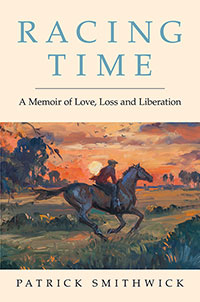
by Patrick Smithwick
Chapter 2 "In Its Own Orbit"
It’s late-June. It’s early-July. It’s late-July. The race is coming up. The A. P. Smithwick Memorial. Every year the date nears, the pressure increases, the excitement builds, post time is in minutes, gamblers rush to the windows, the tape is dropped and the horses are off and running. August—Thoroughbred racing at Saratoga Springs, New York. The best racing in the world. Each decade ushers in a fresh generation of riders. A few veteran trainers fade away; their sons pick up the trade. New, fresh horses run. New owners with new money stand in the paddock. And the A. P. Smithwick—a bulkhead against the roiling whitewater of time, a celebration of my father “Paddy,” Racing Hall of Fame steeplechase legend—remains the same: 2 1/16 miles over hurdles, fast.
Time flows differently at Saratoga. It passes in an unreal, dreamlike state—the town, the lakes, the majestic trees; the horses, Oklahoma training track, the barns, the beauty of the main track and the irreplaceable century-old clubhouse; the betting, the Bentleys, the wads of twenty and hundred dollar bills; the bars, the restaurants, the late nights dancing; the early morning screwdrivers and fresh melons; the early evening scotch, roast beef, perfectly ripened tomatoes and just-picked corn on the cob all remaining consistent, unchanging, pooled in a deep reservoir, while friends, relatives and I launch ourselves, incrementally changed each year, into the current: we marry, have children, introduce them to the Spa, develop careers, leave racing, return to racing, lose the youthful money-making ability to pick winners through hunches, lose the endurance to get by on a few hours sleep per night, gain the wisdom to savor every moment.
When I reflect on past experiences—whether riding my bike around town as an adolescent or riding races as a youth, whether arising at 5:15 and going to the barn with my father or thirty years later arising at 5:15 and going to the barn with my best friend, Hall of Fame trainer Tom Voss—they are recorded in a different manner from my outside-of-Saratoga memories. Most of the time in my life has seemed to have existed as if time were a steadily flowing river and I am with it, the river and I are one; we don’t change much day-to-day or year-to-year, and yet, as we surge and flood, slow and swirl, we see that life and people and places on shore are changing and before we know it, a birthday is coming up, a class reunion is planned, an anniversary is approaching, and it’s a big one—a decade has gone by. Two decades have gone by. In September of 2016, four decades will have gone by, and it will be Ansley’s and my fortieth anniversary.
But when I look back at Saratoga, I see the year as an oval, like a racetrack, much like the mile and an eighth main track at Saratoga. The oval is stretched out, with winter at the top—white and gray; summer on the bottom—faded green, yellow; spring on the left—a lush green; fall on the right—rust. August is an exception; it is red and it is shimmering, flickering. Down on the bottom, right before the track heads up into fall, it intensifies for four weeks: brighter, even more heat, faster paced, much faster, a daily lifestyle like no other, little sleep, much gaiety, go-go-go, action, meeting new people, seeing old friends, making incredible connections, spending money, dishing out twenty dollar bills like they’re ones, and racing—horses, fast horses, the fastest in the world, running day after day as Rolls Royces roll by, actors and millionaire investment bankers step up to the $100 betting window, jockeys head to the jocks’ room and the “hot box” to sweat off another three pounds, trainers stand outside their barns talking to owners.
Read more: Excerpt from "Racing Time, A Memoir of Love, Loss and Liberation"
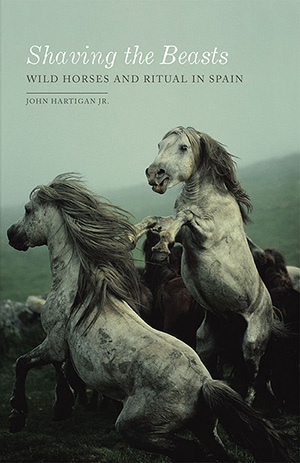
This is an excerpt from Shaving the Beasts: Wild Horses and Ritual in Spain by John Hartigan Jr., a vivid first-person study of a notorious equine ritual—from the perspective of the wild horses who are its targets.
Roughly eleven thousand horses roam the mountainous terrain of Galicia, Spain, in the northwest corner of the Iberian Peninsula. They have inhabited these slopes for millennia and are one of the largest free-ranging populations in the world. Every summer in more than a dozen rural localities, many of these horses are rounded up in a ritual called rapa das bestas, or “shaving the beasts.” The earliest historical accounts of this ritual date to the 1500s, but archeologists argue that this tradition extends from the Neolithic era, based on petroglyphs fea-turing horses being driven into small rock enclosures. That is the heart of the rapa: wild horses, roaming communal lands in the mountains, are herded together and driven into curros—structures similar to rodeo corrals—where their manes and tails are systematically shaved. Their hair, which in the past had many folk uses, falls worthlessly to the ground.
Though they belong to Equus ferus, these animals are called bestas (beasts) or burras (asses), reflecting a widely held view that they are a de¬generate mountain breed. They are intensely disparaged and not con¬sidered “real” horses in comparison with the glorified Andalusians and other Spanish breeds. Smaller in stature than most of their conspecif¬ics, this population features a distinctive body type: they have relatively large bellies and short legs, some feature a distinctive gait, and a few sport a thick “mustache,” which is probably an adaptation to the thorny gorse they feed on extensively. These physical characteristics indicate that this population was certainly passed over by modern breeding re¬gimes, starting with royal projects in the 1400s. That is, rather than a degenerate strain, these are possibly a refuge population that survived when the last Ice Age decimated European horses. That would make them Equus ferus atlanticus, a distinct subspecies from Equus ferus caballus, the domesticated horse.
Read more: Shaving the Beasts: Wild Horses and Ritual in Spain
There is a long history of horses in films and TV, from spaghetti westerns to modern-day classics such as War Horse.
Sometimes, the actors and actresses look as comfortable in the saddle as anyone, whilst with others, their discomfort is plain to see. In some instances, the stars even have stunt doubles to perform their riding scenes, such is their inability to effectively control their mount.
In flicks such as Secretariat, a lot of basic handling seemingly goes out the window, whilst other low-budget movies and TV shows often cannot stretch to training riders for prolonged periods of time. With a larger budget, some excellent riding can be taught over time, and some stars are even good enough for experienced riders to spot and commend.
Viggo Mortensen, for instance, has been known to buy his horses after filming and is a well-known equine fan. He even purchased the horse who played Shadowfax in Lord of the Rings, and not for the first time.
"I bought the one [horse] in Lord of the Rings even though I wasn't with him all the time, I just developed a real good friendship with him,” said the star, who played Aragorn. “His name is Eurayus. He kind of came into the movie like the way I did. You know, did not have much preparation and was just thrown in and had to swim, basically. And it was rough on him and it took a while for us to kind of get in sync and for him to be comfortable around the set.”
by the Equine Info Exchange Editorial Team
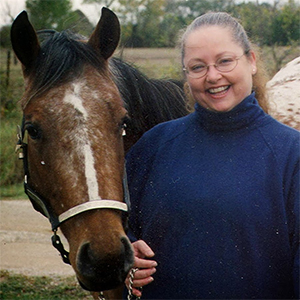
It has been a challenging year for most people and a heartbreaking time for many of us. We recently lost an advisor who quickly became a good friend, Bonnie Marlewski-Probert. We first met Bonnie prior to the launch of the global equine website EquineInfoExchange.com, and she quickly became the “go-to” woman for many aspiring writers and fledgling small business owners whom she encouraged to “push off the edge of the pool” and not to fear sinking. If there’s something about business or technology which she didn’t know (which only happened occasionally), she would research it, learn it, do it, then teach it to anyone who wanted to learn too.
She shared her news with us when she was first diagnosed with colon cancer and then spent two fervent years battling it while writing about her personal journey. Always upbeat, Bonnie was a fighter until the end – many didn’t realize the degree of her illness until she passed away.
We will remember her as a strong and independent, determined woman who had more energy than the Energizer bunny. In her 20’s she ran her own horse farm. She trained many young people to ride and love horses as she did. She was an accomplished author, wrote over 1000 articles for various magazines, was a syndicated columnist, and published many books. She also owned her own publishing company, Whitehall Publishing, where she helped authors through the book publishing process, provided marketing services, and helped build brands. Through this endeavor, she helped hundreds of people realize their dreams of becoming authors and telling their tales. Through her company, Bonnie also worked with many nonprofits to help them raise funds for their charities.
Bonnie is survived by her husband Keith Probert and three sisters, Deb Marlewski, Marie Laschinski, and Pam Marlewski. Per her wishes, please follow the guidelines from the American Cancer Society for cancer screening. An ounce of prevention is worth 100 pounds of cure.
Shortly before her passing, she posted a quote by Mary Anne Radmacher: "Courage does not always roar, sometimes courage is the quiet voice at the end of the day saying, “I will try again tomorrow.”
Read more: Remembering Author, Equestrian, and Publisher Bonnie Marlewski-Probert
by Rae Rankin
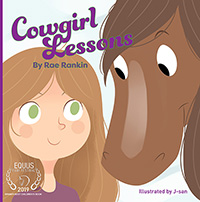
Named Best Children's Book at the 2019 Equus Film and Arts Festival!
For every kid who loves horses. Cowgirl Lessons is a charming story of a girl gathering her gear to head out to the farm and take her weekly riding lesson. From her exasperated mother digging her lost boot from her laundry mound to driving to the barn to see the horse she loves, this story paints the picture of one girl's devotion to horses. Cowgirl Lessons is inspired by a real girl, Duchess the horse, and all the little girls who took their first riding lessons on the sweetest horse ever.
Here's an excerpt!
The first thing I need is a great pair of jeans,
Momma found this pair in a cowgirl magazine.
These are the coolest blue britches I ever did own,
With a horseshoe on the pocket and tiny rhinestones.
From the depths of my closet I grab a clean shirt,
Not one that is covered in grimy, brown dirt.
I pick out my favorite, which is totally cool,
It says in bright letters, “Cowgirls Rule!”
I can’t find my left boot, it’s nowhere to be found,
I look under the bed and through my huge laundry mound.
Momma finds it real quick, she has eyes like a hawk,
I take it from her without as much as a squawk.
Read more: Cowgirl Lessons - An Excerpt from the New Children's Book
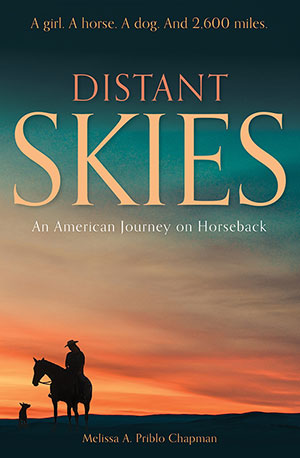
By Melissa A. Priblo Chapman
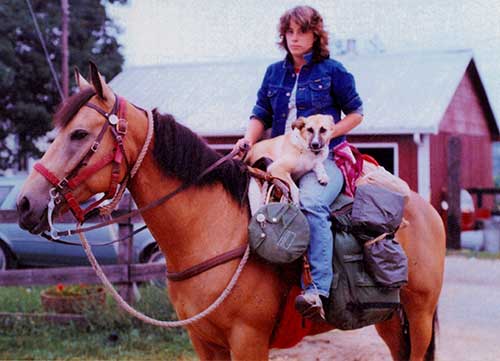
Rainy, Gypsy, and I enjoyed the quiet trail much of the day, but it came to an abrupt end, feeding out onto a busy road just as it clouded up and started to rain with gusto. All three of us stood at the edge of the pavement, shocked by the soaking downpour, when I heard someone shouting.
“Over here! Right here!” A barely visible figure on the other side of the street was waving and jumping up and down. I looked for a break in the traffic and urged Rainy across the road.
The man continued shouting, even though I stopped right in front of him. “Hey! Are you the girl who’s riding the horse around the world?”
I laughed and nodded as he gestured for me to follow him down a driveway and through a garage door. I leaned over and put Gypsy on the ground, then pulled off my hood and jumped down from the saddle. I was surprised to find myself surrounded by people in white aprons, beaming at us. Everyone was talking at once, and I heard several comments of disbelief that “Louie” was actually backing his Cadillac out into the rain for us.
We’d stumbled upon Louie’s Coral Lounge, a tavern and restaurant tucked in the hills of western Pennsylvania. It was Louie himself who pulled me, with Gypsy at my heels, into the kitchen of the restaurant, assuring me his workers would take good care of Rainy while I had something to eat. He handed me a bunch of white tablecloths to use to dry myself off.
“We got a horse in the garage!” Louie proudly informed the staff as he led me through a set of swinging doors into the dining area.
Read more: A Daughter of His Own - Distant Skies: American Journey on Horseback
- In the Reins - Carly Kade’s Equestrian Romance
- The Grey Pony Incident - An Excerpt from The Timid Rider
- Donnie Crevier: Vintage Cars and Fast Horses
- Art of the Cowgirl’s Fellowship Program Inspires Western Artists to New Heights
- Melinda Van Dyck: Life on Stage and on Horseback
- Tossed, Kicked and Broken: 10 Celebrities Get Back on That Horse—or Not
- POP! Goes the West - Andy Warhol Went Thataway
- Joanna Zeller Quentin: Hooked On Horses and Art
- An Artist's Life: Living Through Horses and Their People
- The Smartest Horse That Ever Lived - A True Story