




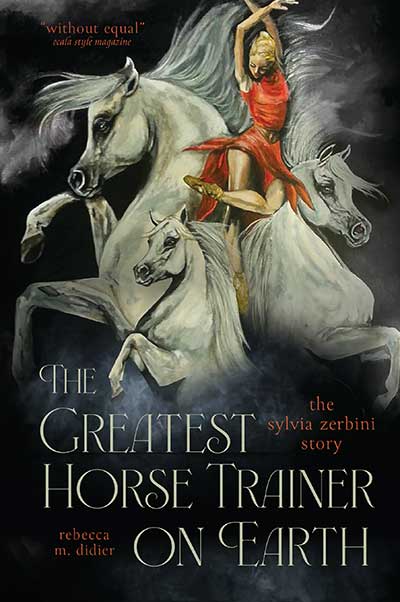
This excerpt is adapted from The Greatest Horse Trainer on Earth: The Sylvia Zerbini Story by Rebecca M. Didier from Trafalgar Square Books, an imprint of The Stable Book Group.
To ninth-generation circus performer and world-renowned liberty trainer Sylvia Zerbini, “working with horses is about freedom—for her, but also for them” (The Press Democrat). “The way I work with horses is different than anyone that I know because of the energy that happens between us,” says Sylvia. That energy is the result of both participants in the interaction, animal and human, as well as the setting, the surroundings, the sights and sounds and smells that the horse’s senses take in and how he interprets and reacts to them. It is the ability to not only tap into the energy but to manage it—to “turn it up” and “turn it down” and move how, where, and when it is concentrated—that, while partly an innate skill, can be nurtured and better employed in each and every one of us, if we’re willing to put in the time.
“Horses react to the energy of those around them,” Sylvia explains, “and when they like what they are doing, they will show off, they will be proud—they need their form of a ‘purpose’ or a ‘reason’ and when they have that, they are fulfilled as an animal. I pick the best parts of a horse and make them bigger.”
I wonder how Sylvia can reconcile the fact that when she trains her own horses, she plays to their strengths and has the space within the realms of liberty performance to showcase what might be a horse’s preferred behavior, but when she is teaching others and perhaps helping them with “problem horses,” there are specific behaviors that are either required or undesired. This, I know, can be perceived the more challenging ask.
“Every time I go into a clinic, I am fixing the person, not the horse,” she explains over her kitchen table. “I have the attitude there is nothing wrong with the horse. He is misunderstood, or the person is applying some kind of pressure unknowingly…. But the biggest thing I come across is people’s timing. They don’t react in the moment. They have to analyze everything.
Sometimes I have auditors [people watching a clinic] and I tell them, ‘I know you are writing your notes, and that is what you are here for, in a way, to learn. But what I am teaching you right now is timing, and when you look down to write your notes, you are missing a big part. For just fifteen minutes this morning, I want you to put your books down while I teach you to be in the moment.’ I need them to watch because when you are working a horse, it is a form of multitasking. You are doing one thing while maybe asking for something else and watching something else…and it all comes down to the timing. I need those I teach to be in the moment and be able to react in the moment. I learned this from my years on the trapeze. My bar was not forgiving—either your timing is on or you’re on the ground. Most of us are so slow, mentally—our thought process is slow, and it is not our fault, but when you are trying to communicate with an animal, that slowness can be very challenging. That, and that lack of confidence that is so common. Horses know I’m not scared. I spent all those years on a trapeze thirty feet up…when I’m on the ground, I have no fear, and horses sense that and I use it.”
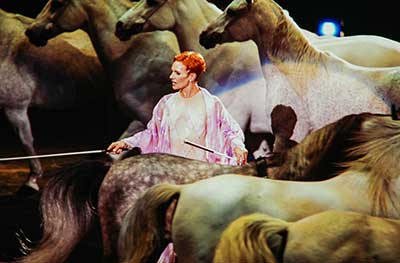
Photo (c) Kenneth Feld | Feld Entertainment
It’s not just a physical energy that Sylvia uses. It is an emotional and mental one. And being so “in the moment,” over any length of time, can be exhausting.
“But when you figure out, it’s magic,” she says. “You can honestly look at a horse and feel the energy coming back to you from the horse, and you can hear this silent language between you, and there is nothing like it. As hard as I work to do what I do, I wouldn’t change it for the world. Life, whatever shape it takes, is hard. We were put here for a reason. Mine is horses.”
To achieve that place where you have a sense of who your horse is, and where he has a sense of who you are, and where you can spend time together that is fulfilling for both of you—that is all life is. Life is about community, whether in a church or a school or a job or a family, where you give something of yourself and others give something of themselves back. When you establish that sense of giving energy and being given energy back, you have achieved the same connection, the same community, with a horse.
“Sylvia’s been called a horse whisperer, but it’s no secret that her close rapport with these graceful steeds is based on love and mutual respect…she insists on personally cleaning the stalls and carefully grooming each horse daily,” notes William G. Johnson in his article for The Ohio Motorist. Luisina Dessagne, author of the biographical retrospective Lorenzo, The Flying Frenchman, highlights a similar trait in her internationally renowned subject. “The countless hours that he spends with his horses,” she writes, “actually lives together with them, observes them, plays with them, and trains them, is one of the secrets of Lorenzo’s success.” The amazing feats Sylvia and Lorenzo (Laurent) achieve with their large groups of horses in performance spaces is proof that taking the necessary time to truly value a horse and who that horse is can yield amazing results.
“Horses just won’t want to do something when there is no connection,” Sylvia says emphatically. “Being a ninth-generation circus performer, I grew up in a world where there was always ‘the trainer.’ Nobody else worked the animals that were performing, whatever animals they may be. The horses had the horse trainer. The elephants had an elephant trainer. Same with the lions and tigers—they had their ‘person.’ The connection was built between them, and you felt it. You felt the animals were a lot calmer, a lot happier, and a lot more relaxed when they weren’t constantly changing which people they’re supposed to listen to and do things for.” She pauses before saying, “It’s hard for horses to trust so many people.”
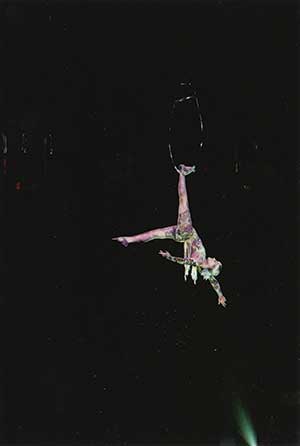
on the lyra 30 feet in the air. Photo from
the private collection of Sylvia Zerbini.
The last statement is an incredibly important one for anybody involved in the modern-day world of equestrian pursuits, and one I feel isn’t considered often enough as the ways of having horses and showing horses continue to evolve away from the model from earlier centuries when most Americans had a horse on their own property for agricultural or transport purposes. As open land shrinks and human lives grow ever busier, many horses experience a parade of caretakers rather than one or two. If they’re boarded elsewhere, their daily needs are met by any number of humans, who may be permanent staff or temporary staff, may have some equine knowledge or very little, and all communicate in different ways. Some may be confident, others timid; some speak constantly, others not at all. They may use their bodies to touch, or they may give wide berth. Add to the mix a “trainer” or “trainers” who work with and ride a horse in order to prepare him for the individual who intends to perform with him, and perhaps exercise riders who condition him when the owner-rider doesn’t have time, and you have even more room for potential confusion and dilution of the connection the horse seeks. If we really think about how the industry works today—how often horses trade hands and how people ride many different horses and how they often aren’t responsible for the hands-on care of their horses—what may truly cause stress in performance horses is not the activity in question, but a lack of connection the horse feels with the human partner in that pursuit.
“I was brought to this farm where they had Warmbloods, top-dollar dressage horses,” Sylvia tells me. “And there were stallions, and I was told they were aggressive. Well, I spent a little time developing a relationship with one of them, and I warmed him up, taught him a little bit of liberty, and got the rider back riding her stallion. But then my rules for that rider are I want absolutely nobody else handling this horse except her and her groom. She needs to not let anybody else handle her horse, for now—maybe in time that can change—but for now, the less contact from different people, the better. A lot of times when I meet a really aggressive horse, I have to ‘wean back’ the number of people that are around him. I can tell right away when there’s multiple hands confusing a horse.
“Think about how, in history, top racehorses or high-level competition horses look for their special groom? That person, that’s their one point of contact, right? There’s that relaxation place, because there is that known person where there’s established trust and the horse is able to go to a relaxed point in a moment of stress. Sometimes, with some horses, it is just a case of too little connection…and a lack of communication.”
This excerpt adapted from The Greatest Horse Trainer on Earth: The Sylvia Zerbini Story by Rebecca M. Didier, reprinted with permission from Trafalgar Square Books, an imprint of The Stable Book Group.
There are more interesting articles in our section on Recreation & Lifestyle.
The Greatest Horse Trainer on Earth: The Sylvia Zerbini Story
BUY NOW on AMAZON
Paperback | Kindle