




Health & Education
We all want the best care possible for our horses. The Heath & Education section covers both Learning Institutions, Organizations as well as many sources for equine assistance including Veterinarians and Farriers.
For those who want a to formally study horses, the Education section includes College Riding, Equine Studies, and Veterinary Schools. Learn about the wide variety of horses in the Horse Breeds section. Supplements and Treatments Therapy are also included in the section.
Everyone can learn from Fine Art and there are some specialty Museums that might surprise you.
Horses as a therapy partner enrich the lives of the disabled. These facilities are listed in our Therapeutic Riding section. To help children and young adults build confidence and grow emotionally, please see the resources available on the Youth Outreach page.
Looking for a place to keep your horse? You can find it in the Horse Boarding section. Traveling? Find a Shipping company or Horse Sitting service if your horse is staying home!
Want to stay up to date with the latest training clinics or professional conferences? Take a look at our Calendar of Events for Health & Education for the dates and locations of upcoming events.
Do we need to add more? Please use the useful feedback link and let us know!
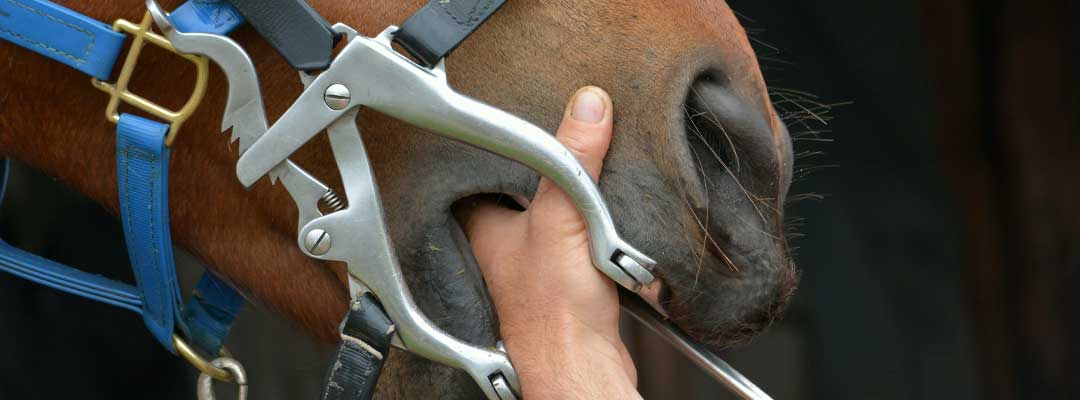
Caring for your horse's teeth through regular dental floats with a veterinarian can keep them on their best behavior.
“Could dental pain be the culprit for your horse’s behavioral problems?” asked Jeff Hall, DVM, senior equine technical services veterinarian with Zoetis.
A study published in the Journal of Equine Veterinary Science established a link between common equine behavior problems and abscessed cheek teeth. Periapical infections or abscessed cheek teeth are common in horses and will usually induce pain that is displayed in your horse’s behavior. According to the research, half of the cases of periapical infections were diagnosed during routine dental examinations, indicating that horse owners were unaware of the association between undesirable behavioral patterns of their horses and dental pain.
Behavioral Problems Linked to Tooth Pain
Common behavioral signs associated with cheek teeth abscesses fall into three main categories.
Eating and drinking
- Eating slowly or taking frequent pauses while eating hay
- Turning his head while eating or dropping hay or grain from his mouth
- Dipping hay in water or avoiding drinking cold water
Bit-related
- Evading the bit
- Headshaking, lolling tongue or opening his mouth when ridden and/or driven with a bit
- Rein contact worse on one side of the mouth
- Resistance to bridling
General
- Withdrawn, intense stare, aggressive behavior or self-harm to his head
- Avoiding social interaction with other horses and people
- Bad-smelling breath
- Poor performance, such as a decline in athletic ability
If your horse is expressing any of these behavioral signs, work with your equine veterinarian to conduct an annual oral and dental examination. Depending on your horse’s age, level of performance and overall condition of the teeth, additional examinations throughout the year may be needed.
What to Expect During a Dental Exam
“I find that horse owners are sometimes hesitate to schedule annual dental exams because they are unsure about what goes into an exam and what their horse will experience,” Dr. Hall said. “Dental exams are a safe, routine procedure that should be conducted by your veterinarian proactively every year.”
A thorough dental exam can take between 10 to 30 minutes and includes:
- An assessment of external structures of the horse’s head and soft tissues (e.g., lips, cheeks and lymph nodes)
- An examination of internal structures (e.g., tongue, palate, gums and cheeks)
- The visualization and palpation of teeth
During examination, veterinarians use a full mouth speculum. A full mouth speculum is a piece of equipment that fits onto a horse’s head, similar to a bridle, with mouth plates that fit between the front teeth to hold a horse’s mouth open. This allows for a more complete visualization and palpation of most aspects of the teeth.
Equine dental care, horse vaccinations and horse wormers all play an important role in their overall health and wellness.
About the author: This content was originally provided by Zoetis, and Jeff Hall, DVM, senior equine technical services veterinarian for Zoetis, with minor additions included from Valley Vet Supply.
This article originally appeared on Valley Vet and is published here with permission. Valley Vet Supply was founded in 1985 by veterinarians for people just like you - people who want the very best for their four-legged friends and livestock.
All photos courtesy of Valley Vet.
There are more informative articles in our section on Health & Education. While you're here, take a look at our Curated Amazon Store.
by Kentucky Equine Research Staff
Many performance horses are exercised at sun-up or earlier. Think about racehorses in training or show horses schooling before early-morning classes. The horses are pulled from their stalls, groomed, and tacked up; trainers and riders discuss the training plan for this daybreak bout of exercise. But does the groom, rider, or trainer think about the horse’s gastric well-being at that time? Maybe, maybe not.
When horses are exercised on an empty stomach, gastric acid splashes onto the squamous, or upper, portion of the stomach. Repeated exposure of gastric acid to this sensitive tissue can increase the risk of gastric ulcers. Prolonging hay consumption into the early morning hours can help protect performance horses from these ulcers. But when do horses eat during the night? Do they consume more hay before or after midnight?
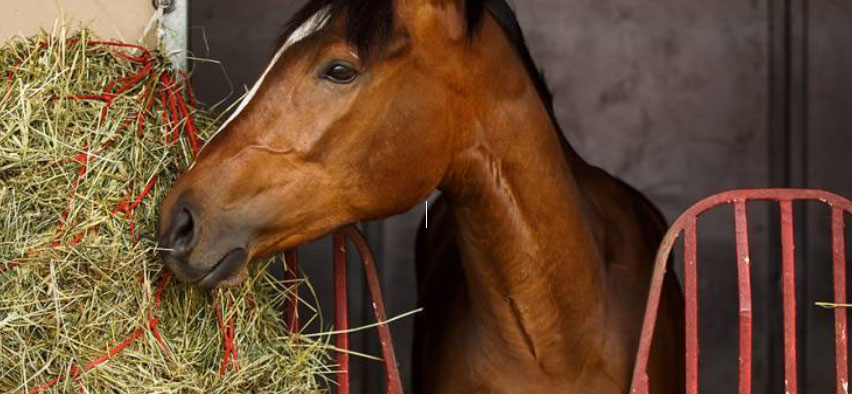
To better understand nighttime feeding patterns, scientists at Kentucky Equine Research recorded horse behavior using two technologies: chewing halters and overhead cameras. They presented hay in various ways (one hay net or two and hay nets in different positions) to determine whether these configurations affected intake behavior.
The researchers outfitted six horses with chewing halters from 7:00 p.m. to 7:00 a.m. and fed them hay equal to about 1.26% of their body weight while stalled. In the first phase of the study, they placed hay in either one hay net or split the hay between two hay nets, positioning the top of each net parallel to the horses’ withers. In the second phase, they tested two positions of hay nets. One treatment included a hay net at withers height, and the second treatment involved a hay net placed much lower, nearly at ground level.
The chewing halters allowed the team to measure how long the horses spent chewing throughout the night, while the overhead cameras revealed when the hay nets became empty.
“Offering hay in different configurations—one net or two, hay net hung high or low—did not affect time spent eating overnight when a limited amount of hay was offered, as it was in this study,” said Ashley Fowler, Ph.D., director of research at Kentucky Equine Research. Most horses steadily consumed their allotted amount of hay until it was gone, with few horses taking significant breaks from eating.
In this study, the researchers stalled the horses to allow easy camera monitoring. Horses in other living situations may benefit from multiple feeding stations. According to Fowler, “We did not observe any advantage to hanging two hay nets instead of one in this study. In larger enclosures, such as dry lots, using multiple hay nets may encourage horses to walk between foraging locations. Horses that need to lose weight may benefit from increased movement.” Even more movement can be encouraged by placing water sources far from forage stations.
Fowler and her colleagues at Kentucky Equine Research are fine-tuning a follow-up study that will allow free-choice access to hay. “If horses are given free access to hay, we believe they will take more breaks during the night to rest, and there may be short bouts of eating rather than one long eating period, as seen in this study,” she said.
Reprinted courtesy of Kentucky Equine Research. Kentucky Equine Research is an international equine nutrition, research, and consultation company serving horse owners and the feed industry. Our goals are to advance the industry's knowledge of equine nutrition and exercise physiology, apply that knowledge to produce healthier, more athletic horses, and support the nutritional care of all horses throughout their lives. Learn more at Kentucky Equine Research.
There a more informative articles in our section on Health & Education. While you're here be sure to visit our Curated Amazon Store.
- 5 Tips About Equine Vaccines
- Five Things About Performance Horse Gut Health
- Using Ultrasound to Diagnose SI Joint Disease in Horses
- Hemp Hurd Bedding for Horses
- What Pasture Snacks Mean for Horse Health
- How would you help a rider who struggles with combinations?
- Descending Gymnastics: Why Ending Smaller Can Be Smarter
- Horse Management Survey Results: A Nutritionist’s Perspective
- Six Key Questions About Platelet-Rich Plasma for Horses
- Potomac Horse Fever
- Drinking Behavior of Horses: Six Facts About Water Intake
- Protein and Muscle Recovery for Performance Horses - an excerpt from Helping All Horses Live Healthier Lives
- Evaluating Horses for Back Pain
- Is Pasture Grazing Safe This Summer for Your Insulin-Resistant Horse
- Chewing Halters: A New Tool to Track Ingestive Behavior and Optimize Welfare
- Barn Construction: 7 Principles to Reduce Fire Risk
- Top 3 Causes of Barn Fires
- Rope Halter Safety and Adjustment with Julie Goodnight
- Crafting Diets for Easy and Hard Keeper Horses - an excerpt from Helping All Horses Live Healthier Lives
- How Horse Show Culture Has Changed (and why it’s worth preserving)