


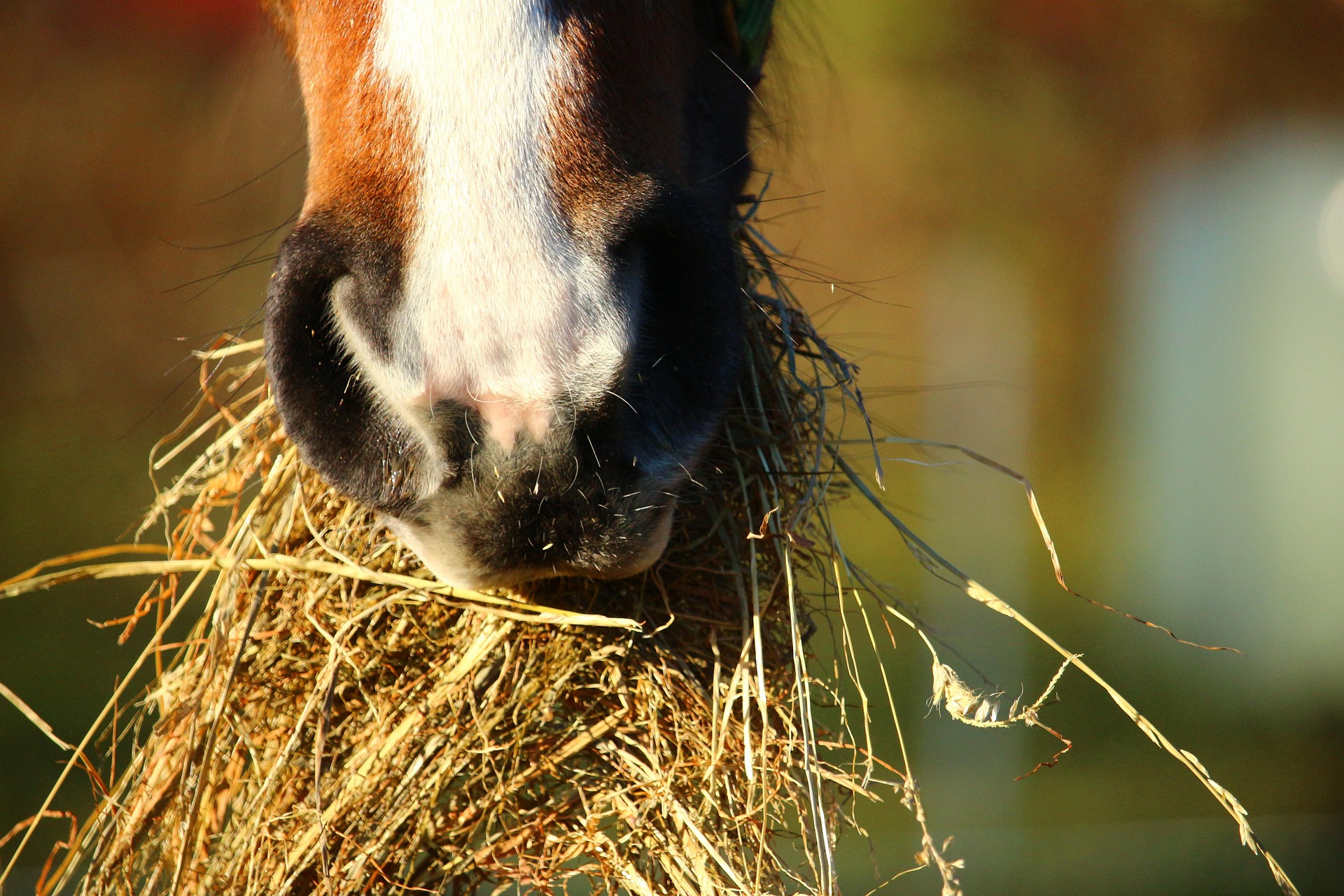
Forage is the foundation of every horse's diet, so learning how to evaluate hay quality is one of the most useful skills an owner can develop. Most horses eat 1.5 to 2 percent of their body weight in forage each day, which means hay makes up the majority of what goes into them. When that hay is clean, well cured, and nutritionally sound, it supports steady digestion, healthy weight, and reliable energy. When it is dusty, moldy, or overly mature, it can lead to digestive upset, respiratory irritation, and lost condition, no matter how good the rest of the feeding program is.
The good news is that you can judge a great deal about a bale before it ever reaches your horse. Here is how to assess hay with your senses, when to go further with a lab analysis, and how to match the right hay to the horse in front of you.
Judge Hay With Your Eyes, Nose, and Hands
Start with a simple sensory check on a few bales from the same load, opening them up rather than judging the outside flakes alone. Look, smell, and feel for these signs of quality:
- Maturity: Hay cut at an earlier stage has more leaf and fewer thick, woody stems and seed heads. Younger, leafier hay is more digestible and more nutritious.
- Leafiness: The leaves hold most of the protein and energy, so a good leaf to stem ratio matters more than sheer length or bulk.
- Color: Bright green suggests good curing and storage, while heavy bleaching, yellowing, or brown patches can point to sun damage, rain damage, or age. Color is a clue, not the whole story.
- Smell: Quality hay smells fresh, sweet, and grassy. Reject anything musty, sour, or moldy, which signals it was baled too wet.
- Feel: Good hay is soft and pliable rather than coarse and brittle, and it should be free of the heavy dust that puffs out when you shake a flake.
- Purity: Watch for weeds, foreign objects like wire or trash, and, in alfalfa, the small but serious risk of blister beetles.
A sensory check tells you a lot about how the hay was grown, cured, and stored. What it cannot tell you is the actual nutrient content, and that is where many feeding problems start. As the Oregon State University Extension points out in its guide to buying hay, look and smell matter, but they are only part of the picture.
Look Beyond Appearance: Get a Forage Analysis
Two bales that look identical can differ widely in protein, fiber, and sugar. The only way to know what you are actually feeding is a forage analysis from a testing lab. A report gives you the numbers that matter: crude protein, fiber measures such as ADF and NDF that reflect digestibility, mineral levels including the calcium to phosphorus ratio, and non-structural carbohydrates, or NSC, which is the combined sugar and starch.
Those numbers are not a luxury. They are essential for horses that need precision: hard keepers and seniors that need more calories, broodmares and growing horses that need more protein, and metabolic or laminitis-prone horses that need forage low in sugar and starch, generally under about 10 to 12 percent NSC. The University of Minnesota Extension explains how forage quality is measured, and the University of Georgia Forage Extension offers a clear walkthrough of how to read a forage report once you have one.
One practical tip: test each hay lot separately. A lot is hay harvested from the same field, in the same cutting, under the same conditions, so its nutrition is consistent within itself but can vary from the next lot.
Because nutrient content shifts from field to field and cutting to cutting, some owners look for a supplier that analyzes every lot before it ships. A lab-tested, consistent forage such as Ultra Premium Timothy Hay takes the guesswork out of it, since you know the protein, fiber, and sugar levels of the exact hay your horse is eating, load after load.
Match the Hay to the Horse
There is no single best hay, only the best hay for a given horse. Grass hays such as timothy and orchard grass offer moderate calories and protein and suit most adult horses in light to moderate work, along with easy keepers. Legume hays such as alfalfa are richer in protein, calcium, and calories, which makes them useful for hard keepers, performance horses, and growing or lactating animals, often blended with grass hay rather than fed alone.
Cutting matters too. A second cutting of grass hay is often finer and leafier than a first cutting, which can make it more palatable for picky eaters and show horses. Whatever you choose, match it to the horse's workload, age, and health, and make any change gradually so the hindgut microbes have time to adjust.
Protect Quality After You Buy It
Good hay can go downhill fast in poor storage. Keep it dry and off the ground on pallets, allow airflow around the stack, and protect it from rain and direct sun. Use the oldest hay first, and stay alert for any bale that feels unusually warm or smells fermented, which can mean it was stored before it fully cured. Buying from a steady, reliable source protects your horse too, since a consistent forage means fewer abrupt diet changes and fewer digestive surprises.
The Bottom Line
Evaluating hay is a skill that pays for itself. Combine a hands-on sensory check with a lab analysis, match the hay to the individual horse, and store and source it with care. Quality forage is the least expensive and most powerful tool you have for supporting your horse's health and performance, one bale at a time.
By Delmar Ropp, Farmers Direct Hay. Delmar is a hay grower with Farmers Direct Hay, a family farm that grows and ships horse hay from the western United States and helps owners match the right forage to the right horse.
There are more informative articles in our section on Health & Education.